


Maintaining high-quality data is essential for businesses to make well-informed decisions and remain competitive. All companies face challenges with data quality. In this article, we will discuss 5 Strategies To Solve Data Quality Issues. In a previous article, we identified the five major types of data quality issues. We also have a video on this topic. But how can a company solve them? We have five strategies to help you tackle data quality issues.
- Prioritize
- Get the Technical Resources Involved First
- Go Back to the Source of the Issues
- Develop a Balanced Strategy Using Technology and People
- Keep Score!
Related Video : Drums and Data 003- Fixing Data Quality Issues That Can Be Hard to Handle
1. Prioritize
If you follow our guidelines, you will have a detailed assessment on the types of data quality issues that appear in your organization and in what quantities. Armed with this information, you now need to decide which issues you are going to tackle.
It can be tempting to try to jump in and solve all of your data quality issues at once. However, it’s more effective to prioritize the most critical issues first.
No company has unlimited resources to devote to improving data quality. By addressing these key areas, you can make significant improvements and gradually work towards resolving other data quality challenges over time. By focusing on the most impactful issues will ensure that your efforts yield the best possible results. This strategic approach allows you to manage your resources efficiently while making steady progress.

2. Get The Technical Resources Involved Early
Involving technical resources early when addressing data quality issues is crucial for several reasons. First of all, the last thing you want is to invest significant time in having people manually cleanse data, only to discover that the technical team cannot use it due to format issues or missing critical information. By beginning with your technical teams, they will provide guidelines on necessary identifiers and other critical elements, preventing scenarios where cleaned-up data is unusable due to missing key information.
Secondly, technical experts can often fix issues with creative means. Power to the nerds! This may eliminate the need for humans to resolve certain scenarios. This will allow your people to focus on the issues that can’t be solved programmatically rather than wasting valuable time fixing issues that a technical resource could address. Partner with your technical folks. You won’t regret it. If your company doesn’t have technical resources that can help, contact us and let’s start a conversation to see if we could help.
3. Go Back to The Source
Imagine the outside water faucet on your house is running. You are using buckets to remove the water pouring out to ensure your basement does not flood. But if you never turn off the water, eventually you will fatigue. Your buckets won’t be enough. The water will keep flowing and sooner or later your basement will flood. The same goes for your data quality efforts. If you don’t go back to the source and fix the root causes, you will never have the higher data quality that you desire. Depending on the root cause, there many be several options available to stop the flow of bad data. Here are a few example suggestions:
- Make a field mandatory in the CRM system
- Educate users on desired format for important data fields
- Add validation logic for critical fields in technical systems to ensure format is consistent
- Ensure drop downs are populated with only correct values
- Add rules to prevent some users from making changes to data
- Improving matching rules in your company MDM platform to reduce duplicates

4. Develop a Balanced Process with Technology and People
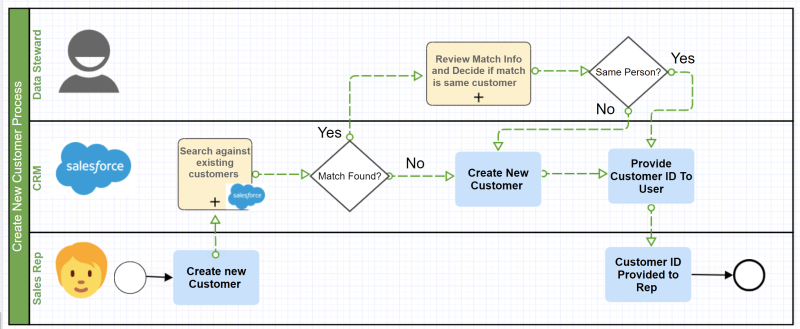
To successfully keep data quality issues at bay in the long run, companies must develop robust processes that involve technology as well as people. This often involves drawing out swim lanes of your processes. This process should answer the following questions:
- When do people need to be involved to resolve quality issues?
- What is the goal of technology in preventing data quality issues?
- Where will data stewards go to see potential data quality issues?
- How will data stewards get their data changes back into the technical systems?
- What rules can be implemented in technical systems to reduce quality issues?
An example of a well designed process for creating a new customer is shown below. Notice the different responsibilities of the people (sales rep and data steward) compared to the technology solution (in this example Salesforce). The goal of this process is to allow sales reps to create new customers. A combination of technology and people will prevent a duplicate customer record from being created.
5. Keep Score
It is essential to keep metrics on the data quality clean-up efforts being conducted. Here are some examples of things you could track:
- Number of email addresses appended to contacts
- Number of duplicate contacts removed
- Number of records where address was standardized
- Count of how many issues data steward teams resolved an issue
Keeping score of your data quality clean-up matters for a couple of reasons. First of all, you can regularly evaluate progress made and determine if any adjustments need to be made to your data quality clean up strategy. For example, if the team has only resolved 10% of the data quality issues you were expecting them to solve, it may be time to evaluate your approach or allocate more resources to the problem.
Secondly, business leadership will need some hard figures when determining budget and ROI of the data quality efforts being made. In short, if you want to continue to get funding and resources, you will need to produce numbers on the impact the team is having to the business.
A data quality dashboard is a great tool to view trends (are contact duplication problem getting better or worse?) and get your hands around the data quality issues in your organization.
Need Help With Your Data Quality Issues?
Integrity Data Insights can help you assess your data quality challenges and come up with a plan to resolve them. Schedule a consultation today to get started